Beauty Service Pricing in 2026: How to Set Yours
Last updated Septembe 9, 2026 · By StyleSeat Editorial Team
A woman you have never met sends a DM at 11pm. How much for a full set?
You type a number. Then you delete it and type a smaller one, because she looked at two other people first and you can feel it. And when you finally send it, your voice goes up at the end of it, the way it does when you are asking rather than telling.
That number is not a guess. It is a calculation you have never been shown how to do.
Beauty service pricing works from the bottom up: what an hour costs you to open the doors, plus what you intend to earn per hour, times the hours the service really takes, plus the product it burns. The shop down the street is not in this equation. Her rent is not your rent, and her speed is not your speed.
Short version
- Your floor is your fixed monthly costs divided by the hours you actually spend on paying clients. At $1,200 in fixed costs and 80 booked hours, that is $15 an hour before you have earned a dollar.
- Price = (cost per hour + the hourly pay you want) x hours the service takes + product. A two-hour service at $15 and $60 with $8 of product prices at $158, so you charge $160.
- Raising 10 services a week by $15 is $150 a week and $7,800 a year. That is the size of the decision you are avoiding.
- On a $160 repeat visit with a 20% tip, you charge $192 and card processing at 2.5% + $0.30 takes $5.10, so $186.90 lands.
Beauty service pricing starts with what an hour costs you
Add up everything you pay whether or not anyone sits in your chair. Booth rent or suite rent, software, insurance, your business phone, laundry, back-bar staples, the card reader. That total is what a month costs you to open the doors.
Then count the hours you are genuinely on a paying client in a month. Not the hours you are at the shop — the booked ones. Most pros overestimate this by a third, and that overestimate is exactly why their prices come out too low.
Divide the first number by the second. That is your cost per hour, and every price you set has to clear it before it pays you anything at all.
| Step | How to get it | Worked example |
|---|---|---|
| Fixed monthly costs | Rent, software, insurance, phone, back bar, laundry | $1,200 |
| Booked client hours per month | Count last month’s actual appointments | 80 |
| Your cost per hour | Fixed costs divided by booked hours | $1,200 / 80 = $15 |
| The hourly pay you want | Your decision, written down | $60 |
| Hours this service really takes | Chair time plus consult, prep and cleanup | 2.0 |
| Product this service burns | Actual cost, not a guess | $8 |
| Your price | (cost per hour + your pay) x hours + product | ($15 + $60) x 2 + $8 = $158, so $160 |
Count the hours the service really takes, not the ones in the chair
A two-hour service is almost never two hours. There is the consult, the strand test, the sweep-up, the sanitizing, the four texts before and the rebooking after. If you price the chair time only, you are working the rest for free and calling it customer service.
Time yourself honestly on three appointments this week, start to finish, door to door. Whatever that number is, put it in the formula. It usually moves a price by $20 to $40 on its own — and it is the least arguable raise you will ever give yourself, because you can point at the clock.
The same discipline handles add-ons. A treatment that adds twenty minutes and $6 of product is not a courtesy, it is a service. Price it and put it on the menu.
Raise it on the calendar before you raise it on everyone
Ten services a week at $15 more is $150 a week and $7,800 a year. You do not have to announce that to your whole book at once. The gentler version is to charge more where demand is already highest and leave your quiet hours alone.
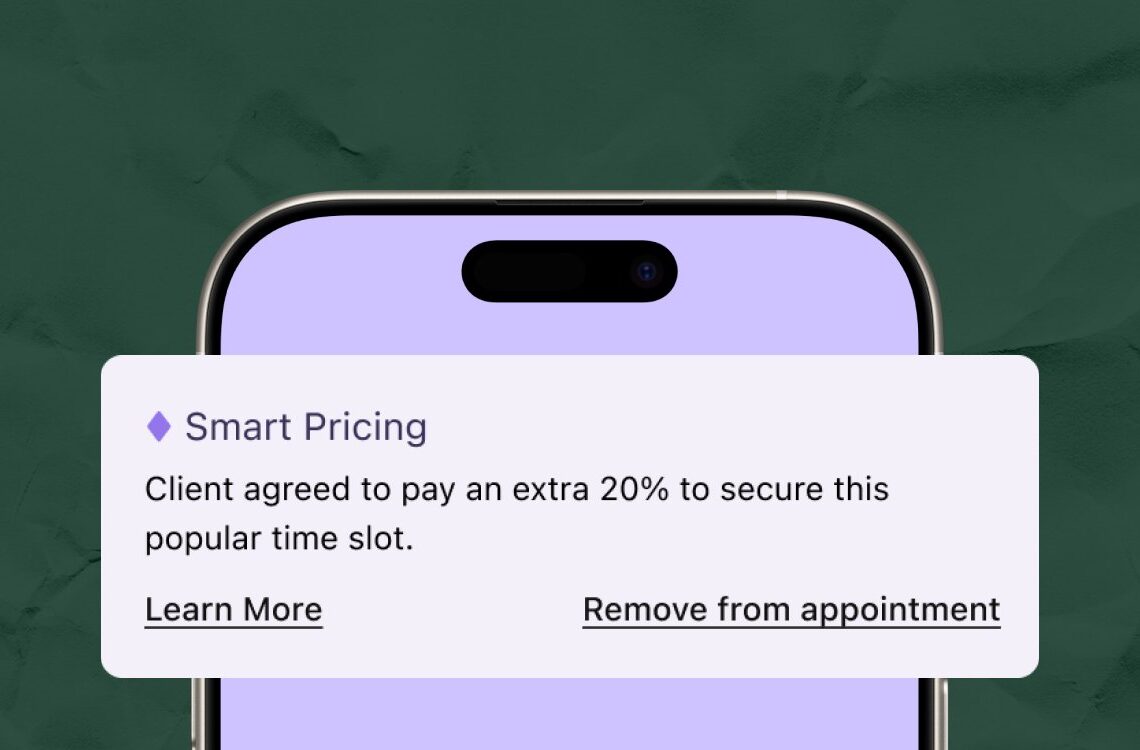
That is what Smart Pricing does on StyleSeat: it raises prices on slots the algorithm identifies as high demand, by up to 50%, and you keep control of it — per service, VIPs exemptable, and you can turn it off. The fee is 5.5% of the service cost, capped at $16.50. On a $160 Saturday booking that fee is $8.80 — it is charged on the service cost, never on the tip — and pros using it see an average of $7,200 a year in additional revenue.
Your Tuesday at 2pm stays $160. Your Saturday at 11am is worth more, and everyone booking it already knows that.
What the price is actually buying
Here is the part the math cannot hold. When you set a full set at $160, you are not selling two hours. You are selling the fact that you can look at somebody’s nail bed and know what will hold and what will lift by Thursday.
You are selling the eleven years it took to get fast without getting careless. The consultation where you talked a bride out of the color she asked for and into the one she cried over. The Tuesday you stayed late for a woman going back to work after chemo and did not charge for the extra half hour, because that day was not about the half hour.
Nobody puts that in a formula, and it is still the reason she picked you. Charging properly for it is not greedy. It is what lets you keep doing it in five years.
How this works on StyleSeat
You set your services, your durations and your prices, and clients book against them. Revenue and net-earnings reporting and the transaction ledger show what actually landed, which is what you feed back into the formula next quarter.
If you turn on Smart Pricing, high-demand slots price themselves within the limits you set. New clients who find you in the marketplace come through New Client Connection: 30% of that first service, capped at $50, once per client and never again, charged only after the appointment. StyleSeat is $35 a month, and here is every fee, written out.
Questions pros ask
How do I set beauty service pricing without guessing?
Divide your fixed monthly costs by the client hours you actually book, add the hourly pay you want, multiply by how long the service really takes, then add the product it burns. At $1,200 in fixed costs over 80 booked hours, that is $15 an hour; add $60 of pay, run it over two hours, add $8 of product, and the price is $158 — so you charge $160.
What do I actually take home on a $160 service?
On a repeat client you charge $192 with a 20% tip, and card processing at 2.5% + $0.30 takes $5.10, so $186.90 lands. If she is a new client who found you through New Client Connection, the fee is 30% of the $160 service, or $48, and you take home $144, assuming a 20% tip. The fee never touches the tip, and it never applies to her again.
Does that 30% get scary on a $600 service?
No, because it stops at $50. On a $600 balayage the new-client fee is $50, not $180, and you take home $670, assuming a 20% tip. Booksy’s Boost charges 30% of a first visit, with a $10 minimum and $100 cap per new client. Fresha’s is 20%, with a cap it shares only after you subscribe, which is where an expensive service gets punished.
Run the formula once, on paper, for the service you do most. If the honest number is higher than what you are charging, you have not been failing — you have been undercharging with excellent technique, and that is the easiest thing in this business to fix. StyleSeat is $35 a month, with a promotion running at $19 right now, and the first 21 days are a free trial — see the pricing before you decide.
Find a pro near you
Book the looks you are reading about — top-rated pros in your city.