How to Price a Tattoo Service

Last updated October 14, 2026 · By StyleSeat Editorial Team
A kid walks in holding his phone sideways. Half a sleeve on the screen, saved from somebody else’s account, no size in mind.
He asks what it would run him. You hear yourself say a number in about three seconds flat.
Then you carry that number around for six hours. You know what the stencil will take. You already know you quoted the drawing at zero.
How to price a tattoo comes down to three numbers. Your shop minimum, your hourly rate, and the design time before anyone sits down. Get those settled once and the counter stops being a negotiation.
Short version
- Your minimum covers setup, not art. 1 fresh station, 1 new needle, ink, and about 20 minutes of turnaround.
- Build your hourly rate from 3 numbers: yearly costs, target pay, and the hours you actually tattoo.
- Quote by the piece past about 4 hours. A slow day should cost you, not the person in the chair.
- Take a deposit that comes off the total. 1 hour of your rate is a clean rule, written down before you draw.
Your shop minimum is a floor, not a price
The minimum exists because a two-inch piece and a half-sleeve cost the same to open. New needle, new tubes, fresh station, green soap, film, gloves.
Add the twenty minutes of setup and the twenty minutes of breakdown. Add the slot on your calendar that nobody else can book.
Price that honestly and you have a floor. A tiny wrist script is not cheaper to run than a palm-sized piece. Your minimum stops it being charged like it is.
One rule keeps the floor working: never quote under it to be nice. That habit has a name elsewhere too: building a service price from what it costs you.
How to price a tattoo by the hour
An hourly rate is not a vibe. It is division, and the numbers are yours.
| The line | What goes in it | An illustration |
|---|---|---|
| What a year costs you to open the doors | Booth rent, supplies, insurance, licence and renewals, card processing, software | $24,000 |
| What you want to earn, before tax | Your own pay, not the shop’s revenue | $66,000 |
| Hours you actually tattoo in a year | Needle time only — not drawing, consults, admin or cleaning | 900 |
| Your hourly rate | (costs + what you want to earn) ÷ hours you actually tattoo | $100 |
Most artists are shocked by the hours line, not the costs line. You are in the shop fifty hours a week and tattooing maybe twenty of them.
That gap is why a rate built on wishful hours comes up short.
Hourly, by the piece, or a day rate
Hourly suits open-ended work. Ongoing sleeves, backpieces, cover-ups where nobody can honestly predict the end.
By the piece suits flash, small repeatable designs, and anything you have tattooed thirty times. You know the time it takes, so you can quote a number and hold it.
A day rate suits full-day sessions and travel. It protects your calendar from a client who books six hours and leaves after four.
Design time gets charged in one of two ways. Fold it into the piece price, or bill a flat drawing fee that comes off the total when they sit.
What you do not do is give it away. Two hours at the light table is two hours, whether or not a needle touched skin.
Deposits, in plain business terms
A deposit is not a platform feature or a trick. It is a business practice you set, write down, and apply to everybody.
Pick a rule you can say out loud in one sentence. One hour of your rate, or your shop minimum, whichever is higher.
If your minimum is $120, a $120 deposit books the date and comes off the final price. It is not extra money. It is the first money.
Then set the reschedule rule in the same breath. Move once with 48 hours notice and the deposit travels with you. After that, it stays with the drawing it paid for.
Put it on your booking page, in your consult message and on the consent form. Read what a deposit does for your calendar next to charging for no-shows and late cancellations.
The hours nobody books
Sunday is the part clients never see. The reference tabs. The three versions of the same ribcage piece, because the second one did not sit right on a curve.
Then the stencil you remake twice on Tuesday, behind somebody trying hard not to breathe.
Six weeks later she sends a healed photo in a bathroom mirror. The lines sit exactly where you put them. That is the job. That is also eleven years of practice arriving in one afternoon.
Your rate is not a tax on her tattoo. It is what keeps you able to do the Sunday.
Quoting and booking the work on StyleSeat
Your services carry your own prices, so a walk-in sees your minimum before they ask. A consult can be its own bookable slot. Your notes, reference photos and client history save against the person, not a lost thread.
StyleSeat is $35 a month, with a promotion running at $19. Two different artists pay for it. One is filling a half-empty week. The other is booked six months out and wants more from the days she already works.
For the first, StyleSeat spends millions a year in ads to find your next client. The fee only exists if one of them actually books you. It is 30% of that first session, capped at $50, charged after the tattoo is done.
On a $200 first session the fee stops at $50. You take home $190, assuming a 20% tip. Everything that client books afterwards is yours, with no fee attached. It does not replace your Instagram or your walk-ins, and it runs alongside both.
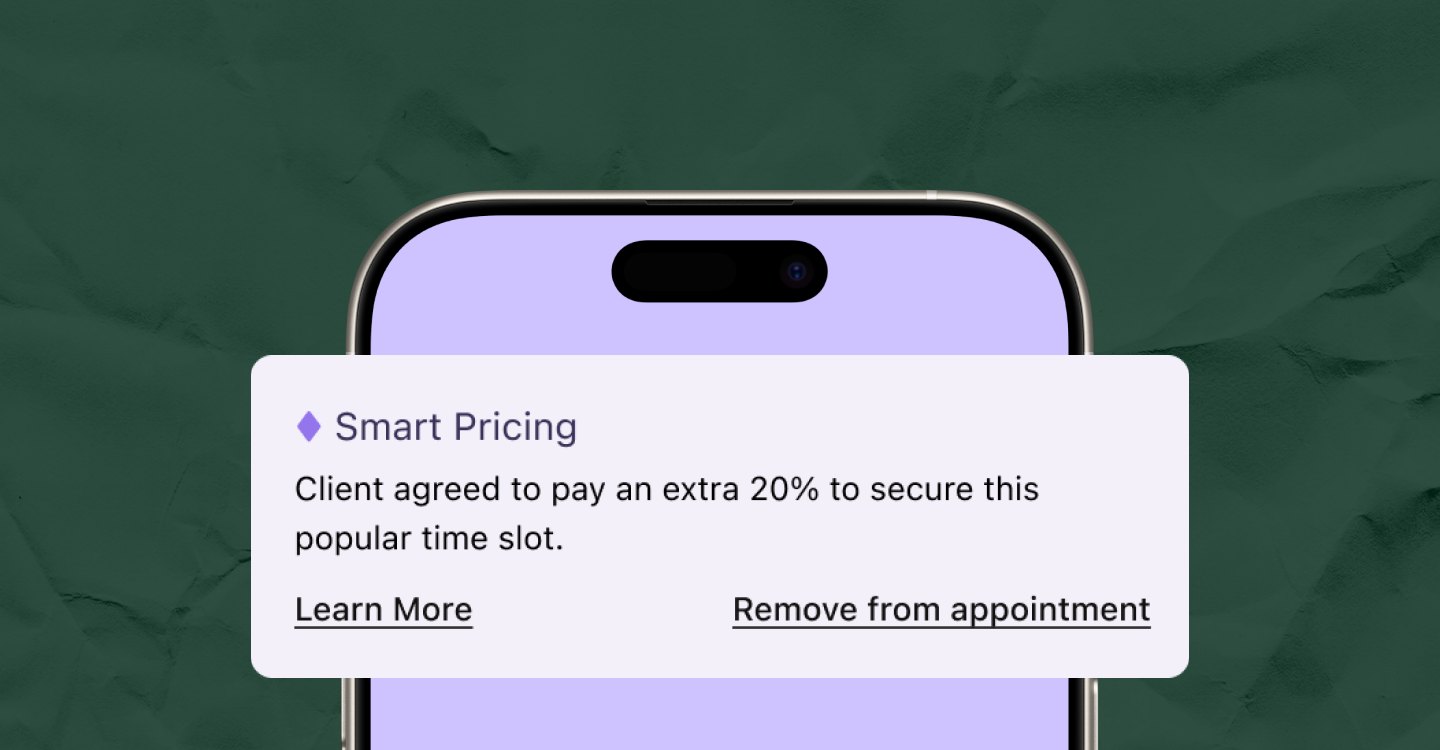
For the artist whose calendar is already full, SmartPricing is the other lever. Professionals who use it average $385 a year in extra service revenue, and the busiest tenth clear over $1,000. StyleSeat charges about 5.5% of each smart-priced appointment for that, capped at $16.50.
Questions professionals ask
How much should I charge for a small tattoo?
Charge your shop minimum, and build that minimum from setup cost rather than size. 1 station, 1 needle, ink, film and about 40 minutes of setup and breakdown. Whatever that costs you is the floor, and a two-inch piece does not go under it.
Should I charge by the hour or by the piece?
By the piece for flash and small repeatable work you have done many times. By the hour for open-ended work past about 4 hours, like sleeves and cover-ups. A day rate suits full-day sessions, because it protects the whole slot.
Do I charge for the drawing time?
Yes, in one of 2 ways. Fold the design hours into the piece price. Or bill a flat drawing fee that comes off the total. Giving away 2 hours at the light table is the quickest way to underprice a year.
What should my tattoo deposit be?
Set one rule and apply it to everybody. 1 hour of your rate, or your shop minimum, whichever is higher. It comes off the final price, and it covers the drawing you already did if the date gets dropped.
What does StyleSeat cost a tattoo artist?
The standing price is $35 a month, with a promotion running at $19 a month. Promotional pricing moves, so check it before you budget. The first 21 days are free, and card processing costs $0 during them.
Write your minimum, your hourly rate and your deposit rule on one index card. Tape it under the counter where you can see it when somebody turns a phone around. The next quote you give is a sentence, not a guess. When the card needs updating, the playbook for raising your rates is there. StyleSeat’s first 21 days are free, so you can check what the $19 promotional rate includes before you move anything.
Find a pro near you
Book the looks you are reading about — top-rated pros in your city.