What Barber School Costs and How Fast You Earn It Back
Last updated September 9, 2026 · By StyleSeat Editorial Team
The enrollment packet has been on the passenger seat a week and you have read the total three times.
Somebody in your family has already said it out loud, in that voice: that is a lot of money for cutting hair. And there you are in the parking lot doing the thing you will be doing for the rest of your working life — arithmetic in your head while somebody waits on you. So let’s do it properly.
Barber school cost is not one number, and any page handing you a national average is guessing. Two licensed schools post real totals of $6,075 and $16,550 for the same license. What you need is your school’s posted total divided by what you keep per haircut, because that gives you a date.
Short version
- Two real published totals: $6,075 at Harris Barber College in Raleigh, $16,550 at The Barber School in Midvale, Utah. Get yours in writing.
- State board fees sit on top. Texas requires 1,000 hours and charges a $50 non-refundable application fee, and it is not in the school’s quote.
- Posted total ÷ what you keep per client = haircuts to break even. At $45 a cut, 317 haircuts on the $16,550 school and 117 on the $6,075 one.
- 317 haircuts is about thirteen weeks at 25 cuts a week. Tuition is not the scary number. An empty chair after graduation is.
Barber school cost is a spread, and the spread has names on it
Here is what two real schools publish on their own sites today — not an average, the totals a human being actually signs for.
| What it is | Where | Published figure |
|---|---|---|
| The Barber School, 1,000-hour program | Midvale, UT | $16,550 total — $13,850 tuition, $2,300 books and kit, $400 in fees |
| Harris Barber College, off-campus program | Raleigh, NC | $6,075 total — $5,000 tuition, $650 tools, $275 books, $150 in other fees |
| Texas Class A Barber license | Statewide, TX | 1,000 hours required; $50 non-refundable application fee |
Same license, roughly $10,475 apart. Housing explains some of it — Harris publishes an on-campus option at $9,550 that includes a room — and the kit explains more. Your number is your number.
The formula: posted total divided by what you keep per client
Every cost-of-entry question in this trade has the same answer shape. Take what you paid, divide it by what one client actually leaves you with, and you get a count you can put on a calendar. What she leaves you with is not the price on your menu — it is the price plus the tip minus the card fee.
| Line | How you get it | Worked example |
|---|---|---|
| What the client pays | Your service price plus a 20% tip | $45.00 + $9.00 = $54.00 |
| Card processing | 2.5% + $0.30 card present on StyleSeat | −$1.65 |
| What you keep | $52.35 | |
| Your school’s posted total | Tuition + kit + fees + state | $16,550 |
| Haircuts to earn it back | Total ÷ what you keep | 317 |
Run the same line on the cheaper school and it is 117 haircuts — under five weeks at 25 cuts a week. The $16,550 school is about thirteen. Neither is a decade, which is what the number felt like in the parking lot.
One honest caveat: that count covers the school and nothing else — not booth rent, not clippers, not product. Add what a month costs you to open the doors on top. The formula does not change, and you still get a date.
The state board is a separate bill from the school
Schools quote tuition. States quote licensing, and the two bills arrive from different addresses. Texas publishes both halves cleanly: 1,000 hours of instruction at a licensed barbering or cosmetology school, and a $50 non-refundable application fee for the Class A Barber license, good for two years. Other states set different hours and fees, and some charge separately for each exam.
Do not let anyone online, this page included, tell you what your state requires. Pull it from your own board and write four numbers on the back of the packet: required hours, application fee, exam fee, license fee. That sum is your true total.
The 1,000 hours are mostly about your hands
Here is the part the cost conversation keeps skipping.
You are not buying a certificate. You are buying the reps it takes before a bald fade stops being a thing you concentrate on and becomes a thing you can do while somebody tells you about their divorce. That switch happens somewhere in the middle of those hours.
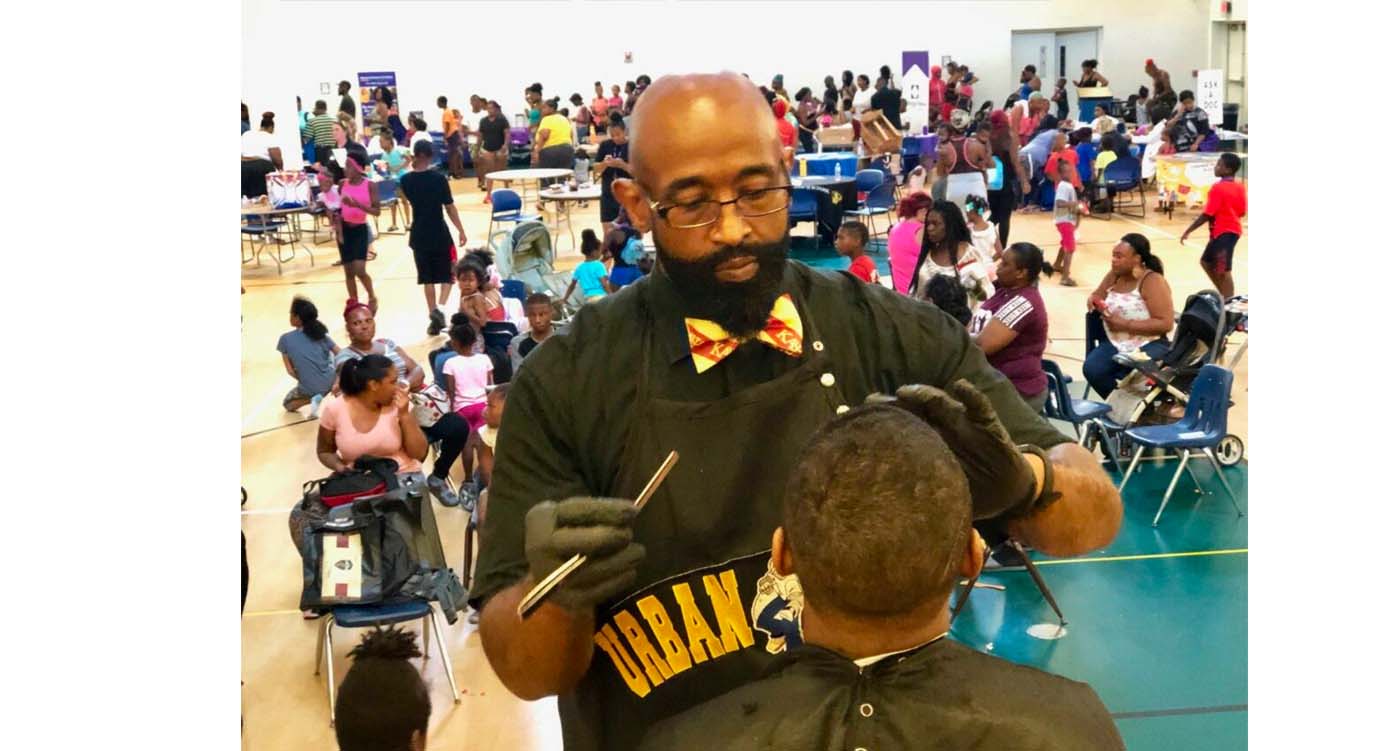
Then one Tuesday a kid sits down who has left three other barbers unhappy, you give him the shape his head actually wants, and he looks up. That look is the whole business, and everything else here exists to buy you enough Tuesdays to keep getting it. The school teaches you the hands. Nobody teaches you the chair being full — that part is on you, and it is worth planning for now, while the packet is still on the seat.
How this works on StyleSeat
The formula only works if the second number is real. StyleSeat’s revenue and net-earnings reporting hands you what you actually kept, rather than leaving you to reconstruct it from a shoebox in April, and the transaction ledger breaks out every fee line.
The other half is the count. A new barber’s problem is rarely the haircut — it is that 317 haircuts needs 317 people who know your name. StyleSeat runs a marketplace and spends millions a year in ads pointing clients at pros, drawing 74M+ visits a year from 2M+ clients actively searching. New Client Connection sends you those requests at 30% of that first service, capped at $50, once per client and never again, charged only after the appointment is finished. You get 24 hours to answer, and less than that if the appointment is sooner, so keep notifications on. Turn the whole thing off whenever you want.
On a $45 cut that fee is $13.50, so you take home $40.50, assuming a 20% tip — it is calculated on the service only, never the tip. Booksy’s Boost is 30% of that first visit, with a $10 minimum and $100 cap per new client. Fresha’s is 20%, with a cap it shares only after you subscribe; StyleSeat’s is 30% too, but it stops at $50 to keep your marketing costs low.
Where StyleSeat does not compete: commission splits, payroll, real inventory, multi-location. If you graduate into a shop running all four, Mangomint and Boulevard specialize in that and are good at it.
Questions pros ask
How much does barber school cost?
It depends on the school and the state, and anyone quoting a single national figure is guessing. Two real published totals as of August 31, 2026: The Barber School in Midvale, Utah lists $16,550 all-in for its 1,000-hour program, and Harris Barber College in Raleigh lists $6,075 off-campus. Add your state board fees to your school’s posted total and treat that sum as your real barber school cost.
How long does it take to pay off barber school?
Divide your total by what you keep per client. At a $45 haircut with a 20% tip, minus 2.5% + $0.30 card-present processing, you keep $52.35 — so a $16,550 school takes 317 haircuts and a $6,075 school takes 117. At 25 cuts a week that is about thirteen weeks and about five, before rent and supplies.
Do I pay the state on top of tuition?
Yes, and it is a separate bill. Texas requires 1,000 hours of instruction and charges a $50 non-refundable application fee for a Class A Barber license, valid two years. Hours and fees vary by state, so pull yours from your own board rather than from any article.
What does it cost to get clients once I graduate?
StyleSeat is $35 a month, currently running a promotion at $19, and New Client Connection costs 30% of that first service, capped at $50, once per client. Top Pros using New Client Connection average $9,800 a year in new-client revenue and 120+ new clients a year. The full cost breakdown is in the help center.
Write your school’s posted total on the packet, add your board’s fees, divide by what one client leaves you with. You end up holding a count — 117, 317, whatever yours turns out to be — and a count has a date attached to it in a way a scary total never does. That date is usually closer than your family thinks. When you are ready to start counting, StyleSeat is $35 a month, $19 during the promotion, and the 21-day trial waives booking and new-client fees the whole way through — the pricing is here.
Find a pro near you
Book the looks you are reading about — top-rated pros in your city.