Signs It’s Time to Raise Your Salon Prices
Last updated October 24, 2026 · By StyleSeat Editorial Team
Your calendar has been full for six weeks straight. You’re turning away new clients, squeezing in extra blowouts before close, and still somehow feeling behind on rent. Something doesn’t add up. A packed book should feel like winning, not like running faster on the same treadmill.
That disconnect is usually a pricing signal, not a scheduling one. Plenty of pros wait years too long to raise their rates, mostly out of nerves. Here’s how to tell when the wait is actually costing you.
Short version
- A calendar booked out more than three weeks in advance is one of the clearest signs your prices are too low.
- Rising product and supply costs eat into margin quietly, even when your calendar looks healthy.
- New clients rarely blink at your rates while regulars barely notice small, steady increases.
- If you’ve added skills, certifications, or better products since your last increase, your price should reflect that.
The signs worth watching
Some signs are obvious. Others hide in plain sight until you actually look for them. Here’s a quick way to check where you stand.
| Sign | What it usually means |
|---|---|
| Booked 3+ weeks out consistently | Demand is outpacing your current price |
| No new client hesitation on price | You may be underpricing relative to perceived value |
| Rising cost of products or rent | Your margin is shrinking even if revenue looks flat |
| It’s been over a year since your last increase | Inflation alone has likely outpaced your rates |
| You’ve added new skills or certifications | Your expertise has grown, but your price hasn’t caught up |
The “booked out” sign is the one pros trust least, oddly enough. It feels like success, so it doesn’t feel like a problem. But a business that’s fully booked at too-low prices is just working harder for the same, or less, money.
What you’re actually charging for
It’s worth pausing on what clients are really paying for when they book you. It’s rarely just the service itself. It’s the years you spent learning how a certain cut moves on different hair textures. The calm you bring to a nervous first-time client. The eye that catches a skin concern before it becomes a bigger one. That judgment doesn’t come cheap to build, and it shouldn’t come cheap to book.
Testing the waters before you commit
You don’t have to guess blindly. StyleSeat’s marketplace connects pros with more than 74 million visits a year. Over 2 million clients are actively searching for services like yours, giving you real demand signals to watch.
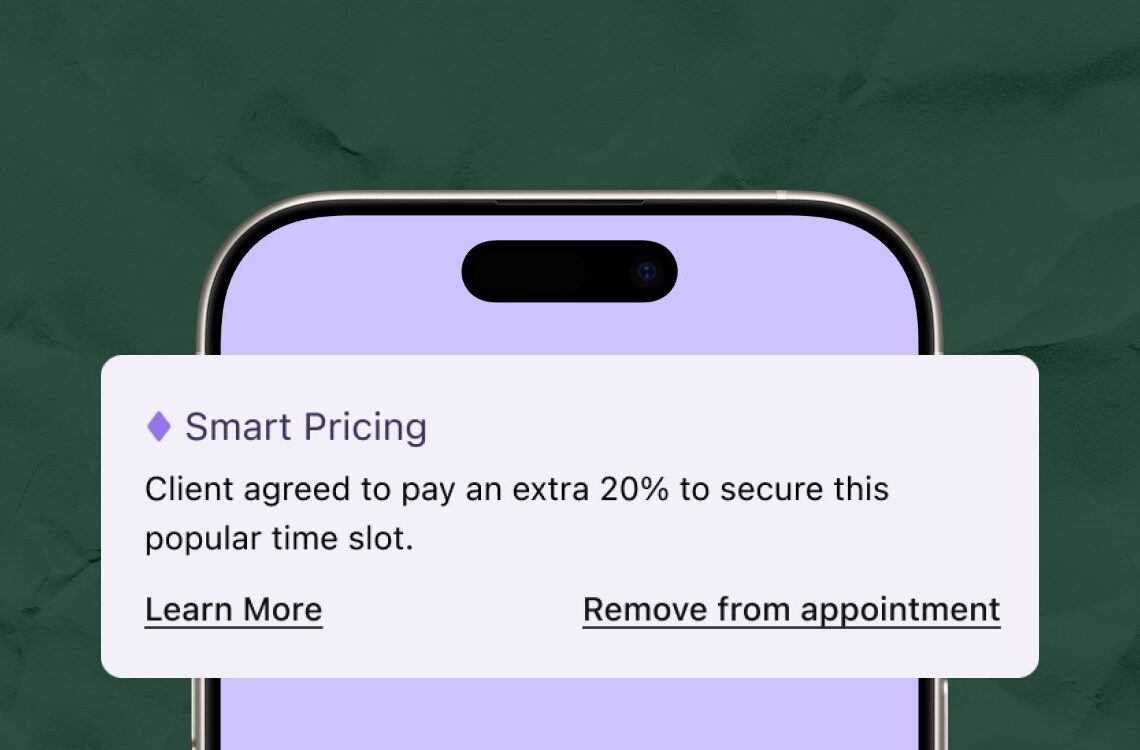
SmartPricing adjusts your rates automatically around your busiest hours. You don’t have to manually test a new number and hope. Pros using it average $385 more annually, and the busiest 10% clear over $1,000. It’s a low-risk way to see what your real demand can support before you commit to a bigger, book-wide increase.
FAQ
How do I know if I’m underpriced?
A consistently full calendar with no client pushback on your rates is the clearest signal. Compare your prices with nearby pros of similar experience for a sanity check.
How often should salon prices go up?
Many pros review pricing annually, adjusting for cost increases and added skill even in years without a major change.
Is it risky to raise prices during a slow season?
It can be, so many pros time increases for a steadier stretch. A small, well-communicated increase is rarely as risky as it feels.
Should I raise all my prices at once?
Not necessarily. Some pros stagger increases by service, starting with the ones in highest demand first.
A full calendar is proof that people want what you do. The next step is simply making sure your prices reflect that same demand. Raising your rates isn’t greedy. It’s just catching your business up to the reputation you’ve already built.
Find a pro near you
Book the looks you are reading about — top-rated pros in your city.