Licensed vs Certified Lash Tech: What You Need

Last updated September 9, 2026 · By StyleSeat Editorial Team
The certificate came through as a PDF the night the course ended. Your name in a script font, a gold seal, a two-day date range.
You printed it and taped it inside the suite, because you earned it. Half of that class was you and a mannequin and tweezers you could not hold still.
Then a client asks, on her way out, whether you are licensed. And you realize you are not sure what the honest answer is.
Here is the licensed vs certified lash tech difference in one line: a certificate says a training company taught you, and a license says your state gave you permission to work on a paying client. Only one is issued by a government, and only one gets checked when an inspector walks in.
Short version
- A certificate comes from a private course; a license comes from your state board. A two-day class cannot hand you the second one, whatever the flyer said.
- Which license covers lash extensions is set state by state. Ten minutes on your own board’s site is the only version of this answer worth trusting.
- A $150 full set from a new client through New Client Connection costs 30%, or $45, and you take home $135, assuming a 20% tip. A $1,200 course pays for itself in nine of those.
Licensed vs certified lash tech: one comes from a school, one comes from your state
Certification is a private transaction. A brand teaches a curriculum, you finish it, they issue a document saying so. There is no national lash board behind it; its value is exactly the reputation of whoever signed it.
A license is a different animal. It comes from a state agency, it has a number, it renews, it shows up in a public lookup, and it is what makes it legal to charge for putting adhesive near an eye.
| Course certificate | State license | |
|---|---|---|
| Who issues it | A training company or academy | Your state board |
| What it proves | You finished their curriculum | The state permits you to work for pay |
| Who checks it | Insurers, landlords, clients who ask | A state inspector, and the board on a complaint |
| Legal to charge | Not on its own | That is the whole point of it |
Your state board writes the rule, and it changes two states over
There is no national answer to what license a lash artist needs, and anyone who gives you one without asking where you live is guessing. Some states fold eyelash extensions into cosmetology, some put them under esthetics, and a handful have a lash-specific credential with its own hours and exam. Which is why a confident answer in a Facebook group is the most expensive thing you can act on: the woman typing lives somewhere else.
Search your state’s name plus board of cosmetology, open the board’s site rather than a school’s, and write down four things:
- Which license type covers eyelash extensions where you live, by its exact name
- The hours it requires, and whether your course hours count toward them
- Whether there is a written exam, a practical exam, or both
- Whether your room or suite needs its own establishment license
That last one catches people: in many states your license and the building’s license are two separate documents, and the second is the landlord’s job. If the board’s site is unreadable, call them.
The certificate is still worth something, once you stop calling it a license
A license proves the state is satisfied. It says nothing about whether you can map an eye or keep a set alive to week three in August humidity — that is what the course was for, and what your clients feel. It also does paperwork duty: insurers ask what adhesive systems you trained on. Keep it where you can find it in ninety seconds, beside a photo of your license and its expiration date.
The part nobody certifies is the two hour experience you give your client
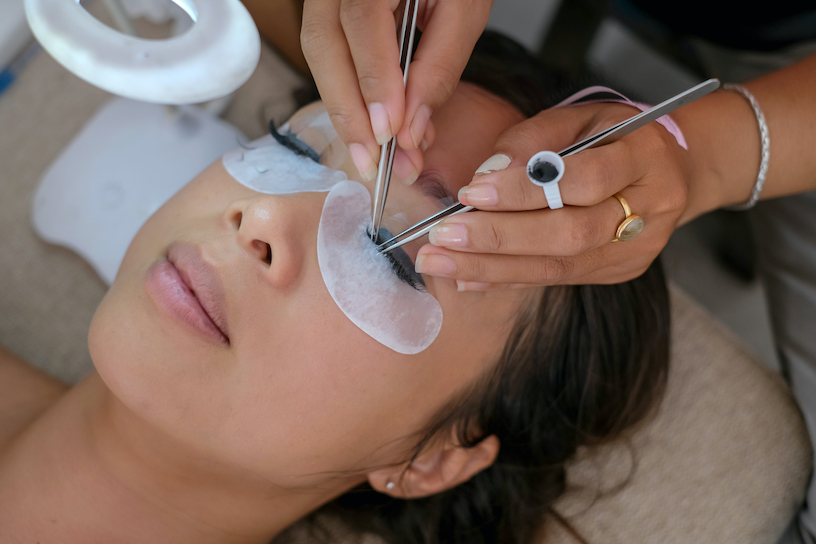
Your Tuesday is quiet in a way most jobs never are. The door is closed, the light is right, and a woman you have known two years is flat on her back telling you about her mother, then going silent, then falling asleep the way people do when they finally trust somebody.
Meanwhile you are three inches from her face, isolating one lash at a time, adjusting the map because her left eye sits lower than her right and always has. Your shoulders are up around your ears; you will not notice until you stand.
Then she wakes up, looks in the mirror, and does the thing — the small quick inhale before she says anything. No board tests for that, and it is why she comes back every three weeks for years instead of price-shopping you.
What a full set actually leaves you
Once the paperwork is settled, the math decides whether this is a job or a business. A course is a cost with a payback period, and it is short once you know your take-home per set.
| What you charge | Who is booking | What comes off | What lands |
|---|---|---|---|
| $150 full set | New client, New Client Connection | 30% of the service, $45 | $135, assuming a 20% tip |
| $250 volume set | New client, New Client Connection | The $50 cap, not 30% | $250, assuming a 20% tip |
| $150 full set | A client you already had | 2.5% + $0.30 on $180 | $175.20, assuming a 20% tip |
Run your own payback: course and kit divided by what a full set leaves you. At $1,200 and $135 a set, that is nine clients. Not nine months — nine people.
And look at the $250 row: 30% would be $75, but the fee stops at $50. Booksy’s Boost charges 30% of a first visit, with a $10 minimum and $100 cap per new client. Fresha’s new-client fee is 20%, with a cap it shares only after you subscribe — StyleSeat’s stops at $50, once per client, ever.
How this works on StyleSeat
Once you are legal, the problem stops being paperwork and becomes strangers — a licensed lash artist with an empty Tuesday has a demand problem, not a skill problem. New Client Connection sends you requests from people searching the marketplace in your city. You have 24 hours to accept or decline, less if the appointment is sooner, so answer fast. The fee lands after the service, only for a client you did not already have, and never again for her. You can turn it off any time. Here is how the pieces fit.
The rest is ordinary lash-book machinery: reminders so a fill does not evaporate, a client record holding her map and adhesive, Smart Waitlists offering a cancelled slot to someone who wants it. Email and text marketing, analytics and review management are in the base price. What StyleSeat costs is published here.
Questions pros ask
Licensed vs certified lash tech – what is the actual difference?
A certificate comes from a private training company and proves you completed their course. A license comes from your state board, carries a number, renews on a schedule, and is what makes it legal to charge. Two days of training gets you the first; the second has state-set hours and usually an exam.
My lash course said the certificate is all I need. Is that true?
Not on its own, and no course can promise it for you, because the requirement is written by your state rather than by the academy. Some states cover eyelash extensions under cosmetology, some under esthetics, a few under a lash-specific credential. Ten minutes on your board’s site gets you the license name, the hours and the fee in writing.
What does a full set actually leave me after fees?
On a $150 full set for a client you already had, you charge $180 with a 20% tip, card processing at 2.5% + $0.30 takes $4.80, and $175.20 lands. If she is new through New Client Connection, the fee is 30% of the $150 service, or $45, and you take home $135, assuming a 20% tip. That fee is charged once for her and never again.
Answer the license question this week, while it is a ten-minute task and not a letter from the board. Then put the certificate back on the wall, because you did earn it, and go be findable. The number to aim at is $9,800 — what Top Pros using New Client Connection average in new-client revenue a year. Getting there costs $35 a month, or $19 while the promotion is running, after 21 free days: the pricing page.
Find a pro near you
Book the looks you are reading about — top-rated pros in your city.