How Much Do Salon Owners Make? The Real Take-Home

Last updated October 14, 2026 · By StyleSeat Editorial Team
Friday, 7:25 p.m. The last client is under the dryer and you are at the desk running payroll.
Five stylists. Commission, then the taxes on the commission, then the girl at the front desk. Rent came out Tuesday. The colour order came out Wednesday.
Everyone gets paid, and then you look at what is sitting there for you. Some months it is fine. Some months it is less than your busiest stylist took home.
So, how much do salon owners make? There is no sourceable national figure, because no federal occupation code exists for salon owners. The hairdresser wage you will find quoted describes employees, not the person who signs their checks. Your number is whatever survives the formula below.
Short version
- No national average exists for owners. Government wage data covers employed hairdressers, and it excludes pay for self-employed workers.
- Owner pay is a remainder, not a salary. Chair revenue, minus payroll, rent, product, processing and the rest.
- In the illustrated five-chair month, $37,500 came in and $6,419.50 was left. That is $77,034 across twelve months like it.
- Payroll ran just under 54% of revenue. Watch that one percentage and you can see the month coming.
No published figure says what a salon owner makes
People quote one anyway. It is usually a hairdresser wage lifted from federal data and relabelled.
That is the wrong number twice over. Government wage figures measure what employers pay employees. They also state plainly that they exclude pay for self-employed workers.
An owner is neither. You are not on an hourly rate and you are not on commission. You are the last line of your own profit and loss statement.
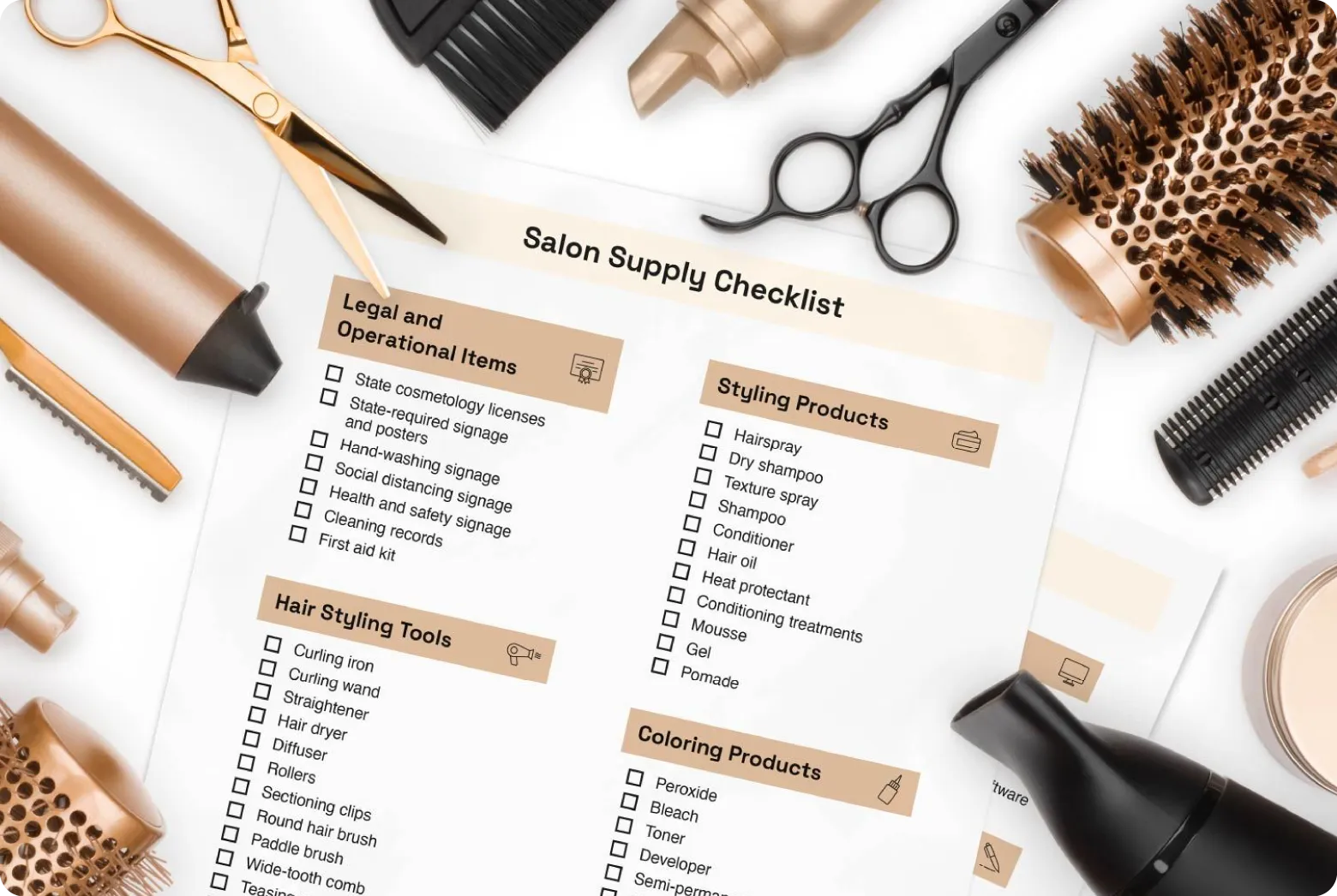
Which is why two owners in the same city, with the same five chairs, can be $40,000 apart. Much of it is set on the day you sign the lease. So the checklist for opening a salon repays a slow read. Same haircuts, different lease, different commission split, different product waste.
So nobody can tell you the number. The formula, though, is identical everywhere, and you can run it tonight.
The owner formula, in the order it happens
Write it down in this sequence, because this is the sequence the money actually leaves in.
Service revenue plus retail. Minus commission. Minus the taxes on that commission. Minus front desk wages. Minus product. Minus rent. Minus card processing. Minus everything else that is open-the-doors money. What is left is yours.
Three of those lines are where owners go wrong, every time.
Payroll taxes are not optional and not small. Employer taxes and workers compensation add roughly a tenth again on top of commission. Budget for them as a line, not a surprise.
Retail is not revenue. Half of a retail dollar is the cost of the bottle. Put the cost of goods in, or retail flatters the month. Selling retail properly still lifts the top line without adding hours.
Your own chair is a separate business. If you still take clients, keep that revenue and that commission on their own lines. Otherwise you cannot tell whether the salon works or whether you do.
What salon owners make on a five-chair month
| Five-chair commission salon, one month | Amount |
|---|---|
| Service revenue, five stylists at $7,000 | $35,000.00 |
| Retail sales | $2,500.00 |
| Total revenue | $37,500.00 |
| Stylist commission at 45% of service | −$15,750.00 |
| Employer payroll taxes and workers comp, 12% of commission | −$1,890.00 |
| Front desk wages | −$2,600.00 |
| Colour and backbar, 8% of service | −$2,800.00 |
| Cost of retail goods sold | −$1,250.00 |
| Rent | −$4,200.00 |
| Card processing, 2.5% + 30¢ across 560 tickets | −$1,105.50 |
| Booking and payment software | −$35.00 |
| Liability insurance | −$180.00 |
| Utilities | −$420.00 |
| Marketing | −$350.00 |
| Laundry, cleaning and supplies | −$300.00 |
| Education | −$200.00 |
| Total costs | −$31,080.50 |
| Left for the owner | $6,419.50 |
Twelve months at that level is $77,034 before tax. Move the split to 50% and commission plus its taxes rises by $1,960. The same month then leaves $4,459.50.
Payroll is the line that decides the month
Add commission, employer taxes and the front desk together. In the month above that is $20,240 against $37,500 of revenue.
Just under 54%. That single percentage is the whole business in one figure, and it is the one to track across twelve months.
When it creeps, it creeps quietly. A split moves up for one stylist you did not want to lose. Then another asks. Then a slow February arrives and the front desk cost does not shrink with revenue.
Two levers move it. Raise the average ticket, or raise the number of tickets each chair turns. Discounting moves it the wrong way, because commission comes off the discounted price while your rent does not.
And tips never touch this line at all. A tip belongs to the stylist who earned it. On an $85 colour, a stylist on 45% takes $38.25. Add $17.00 on a 20% tip and she has $55.25. None of that is yours, and it should not be in your forecast.
Protect the chair time instead. A clear policy on no-shows and late cancellations is worth more to five chairs than any discount.
Thursday at four, in your own chair
You still keep two days on the floor, and Thursday afternoon is the one you would not give up.
Your four o’clock has been coming since before the second chair existed. She brought her mother. Later she brought her daughter, who is now old enough to have opinions about her fringe.
Across the room, the newest stylist is sectioning a head of fine hair and getting the panels too thick. You walk past, move her hands an inch, say nothing, keep going. She fixes it and does not mention it either.
That is the part nobody put in the lease. You built a room where somebody learns to do this properly. You built a chair somebody has sat in for eleven years.
Where StyleSeat fits a five-chair salon
Start with the boundary. StyleSeat does not run payroll and does not split commission for you.
Mangomint and Boulevard specialize in exactly that, along with real inventory down to stock levels. They are good at it. If payroll is your daily pain, go and look at them properly.
StyleSeat is built for small salons from the other direction. Staff calendars come at no extra cost. A small-salon setup with a receptionist and shared calendars is in beta. Multi-location is supported. Each professional keeps her own account and her own subscription.
What it adds that a scheduler cannot is clients. StyleSeat spends millions a year in ads to find your next client. You pay only on results: no new client, no fee. The fee is one time per new client, 30% of the first visit, capped at $50, charged after the service. Then you keep the client, because rebookings carry no fee.
Price both sides of that. Say three new clients land in a month at $85 each. That is $255 of service revenue a platform with no marketplace cannot produce. The one-time fees come to $76.50, so $178.50 is net new money in the salon. That sits alongside the marketing you already run rather than replacing it.
Smart Pricing works on the chairs you already fill. It lifts the price on slots that were already booking, by up to 20%. Professionals who use it average $385 a year in extra service revenue, and the busiest tenth clear over $1,000. StyleSeat charges about 5.5% of a smart-priced appointment, capped at $16.50.
Software is $35 a month, with a promotion running at $19. On the month above that is one line out of fifteen. Tax tips for owners and independent stylists covers the rest of them. Your own tax professional should confirm every line.
Questions professionals ask
What is the average salon owner salary?
There is no sourceable national figure. No federal occupation code covers salon owners, and published hairdresser wages measure employees. Owner pay is whatever is left after payroll, rent, product and processing.
How do I calculate what I actually make as an owner?
Take service revenue plus retail. Subtract commission, payroll taxes, front desk wages, product, rent, processing and fixed costs. In the illustrated month that runs $37,500 down to $6,419.50.
What percentage of revenue should payroll be?
Track your own rather than chasing a benchmark. In the five-chair month above, commission, employer taxes and the front desk came to $20,240. That is just under 54%.
Do salon owners get a share of tips?
Tips belong to the stylist who earned them. On an $85 colour, a stylist on 45% takes $38.25, plus $17.00 on a 20% tip, for $55.25. Keep tips off your revenue line.
Does StyleSeat do payroll and commission splits?
No. Mangomint and Boulevard specialize in payroll, commission splits and stock-level inventory. StyleSeat is built for small salons and carries staff calendars at no extra cost. It costs $35 a month, with a promotion running at $19.
You cannot buy a national average, and you would not want one. You can run your own five lines tonight and know exactly which one is eating the month.
Then fill the chairs. StyleSeat runs $35 a month, promoted at $19 right now, with 21 free days to try it. The full price breakdown lives here.
Find a pro near you
Book the looks you are reading about — top-rated pros in your city.